
In the hands of Kelani Abass, Delali Ayivi, Nuits Balnéaires, Djibril Drame, and Sharon Walters, images do not resolve into evidence; they are worked, layered, and re-situated to operate as passages between the visible and the sensed.
What binds Seeing Otherwise is a shared attention to spiritual–material entanglement: an understanding that images are not inert surfaces, and that belief is never detached from the gestures and environments through which it moves.
Works from Drame’s Migration and Identity series present images as layered artifacts. Photographic portraits are woven into materials that circulate through everyday life such as rice bags, objects marked by trade routes, labour, and reuse. Each piece bears the weight of movement, with seams, folds, and frays becoming part of the composition, tracing lives shaped by circulation and adaptation.
Ayivi’s layered photographic works, too, resist closure. By painting onto the backdrop as the image is taken and again onto the surface of the finished photograph, she disrupts photography’s archival role as an arbiter of truth and possession. Colour and gesture are not applied as embellishment but as active forces that bend the image toward touch, play, and duration. Her practice insists on the inseparability of the numinous and the physical, honouring the fluid, relational lives of her subjects.
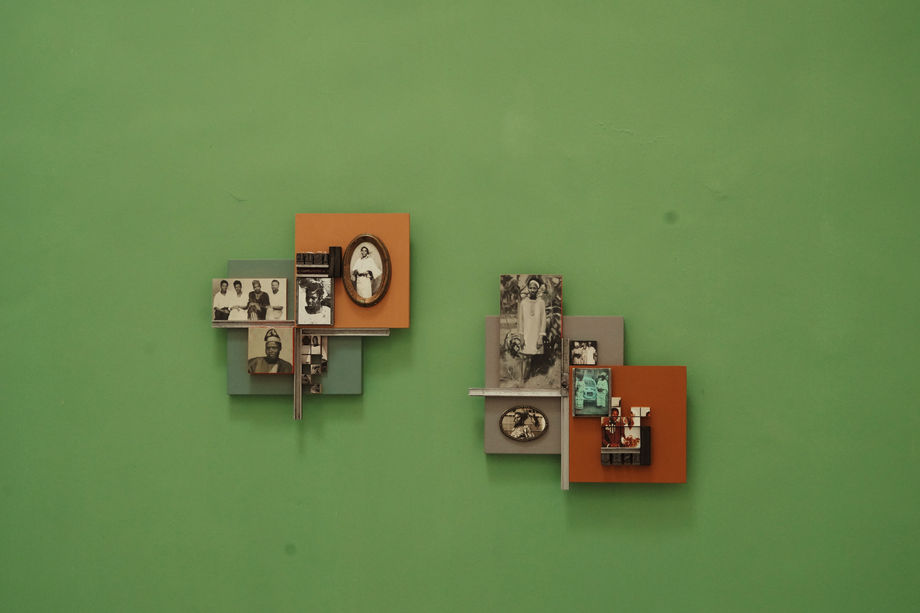
Abass approaches photography as a site where material process and immaterial inheritance converge. Drawing on his background in letterpress printing and painting, he forges a knowledge of how all forms of material can be manipulated and how archival technologies shape historical recall. Mimicking the ‘chase’, a metal frame used in letterpress to hold text and image in place, he cuts, reprints, inks, and mounts images onto sculptural supports to create dialogue between past and present, analogue and digital. These acts of handling summon the image into activation through touch, labour, and belief. Memory, in Abass’ work, is not simply preserved but reassembled through physical encounter, positioning the archive as a medium through which time is navigated and testimony remains in motion.
Balnéaires offers a different but resonant approach to melding the image as threshold. His multimedia practice leans into atmosphere, devotion, and the long afterlife of feeling. In featured works such as Jour de fête, a procession during the yam festival in Balnéaires’ village becomes a choreography of transmission: romantic, transgenerational, and collective forms of love braided into a single rite. Rather than extracting scenes from communal life, his work brings into focus how ritual organises time and memory.
Walters’ layered works approach photographic images as grounds of both concealment and revelation. Articulated through silhouette-like, redacted self-portraits, outlines in her works such as Longing and Belonging are filled with urban scenes drawn from the visual rhythms of Lagos, accumulating into quiet expressions of nostalgia. Through cutting, overlay, and assemblage, Walters allows shadowed form to contain the residue of an interior past. Her pared figures neither fully withdraw nor fully declare themselves; instead, they press gently against the limits imposed on how Black subjects are seen.
The exhibition is configured along an axis shaped by migration, transmission, and reconnection. To move between such in this context is to encounter photography as a practice of relation— where each artist has both evolved and collapsed the bounds of their practice to explore the dynamics of their West African heritage and cultures.